
Europe generates over 17 kg of e-waste per person, every year.
The e-waste landscape in Europe is a complex challenge of rising consumption, resource scarcity, and ambitious environmental policy.
We're turning that waste into a valuable resource.
The RETURN process is a cutting-edge solution for the recovery of valuable metals and critical raw materials from e-waste with 99% efficiency.
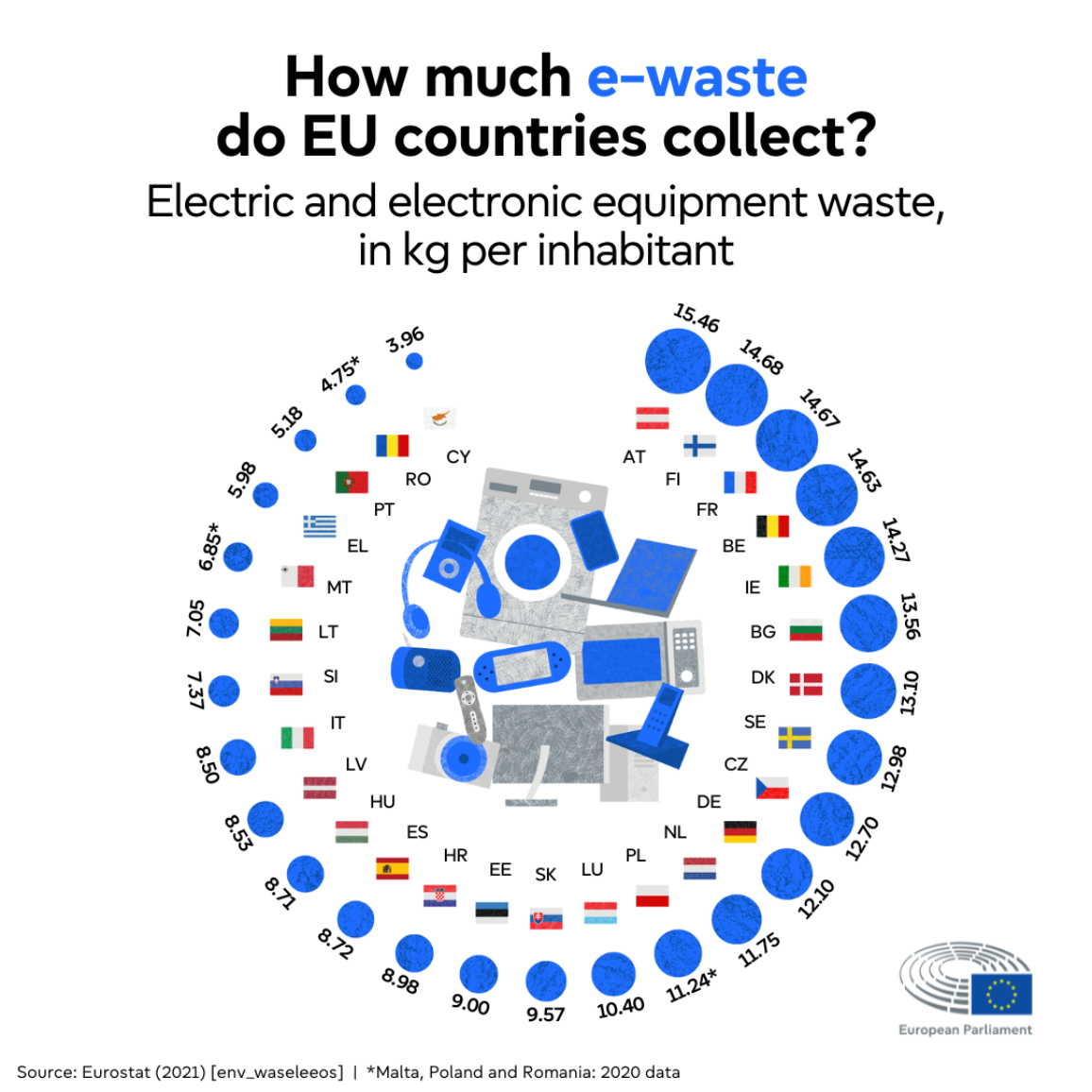
The Big Picture: Europe's E-Waste Problem in Numbers
Key Statistics:
-
Generation: 17.6 kg of e-waste generated per capita in Europe (the highest in the world). (Source: UNITAR, 2024)
-
Collection: Only 40.1% of this waste is officially collected. (Source: Eurostat, 2022 data)
-
The Gap: The EU’s ambitious 85% collection target is being missed, creating a massive, untapped stream of valuable materials.
Image Source: European Parliament based on Eurostat data
The European Topics around E-Waste
E-Waste Recycling & Urban Mining
We are surrounded by “urban mines” – a vast resource locked away in our old devices. Modern recycling goes beyond shredding; it’s precision recovery.
Did you know that one ton of mobile phones can contain 100x more gold than one ton of a good quality gold ore?
References: E-Waste Monitor
Circular Economy & EU Policy
New EU policies are forcing a radical shift from a “take-make-waste” model to a circular one, where products are designed for repair, reuse, and recycling.
The EU’s “Right to Repair” and new WEEE Directive (2024) are making producers responsible for the entire product lifecycle.
References: EU Circular Economy Act
Critical Raw Materials (CRMs)
Lithium, cobalt, and rare earths power our green and digital future. Securing a stable, ethical supply chain starts with recycling what we already have.
The EU’s CRM Act aims to recycle 25% of its critical materials by 2030, but today only 1% of rare earth demand is met by recycling.
References: EU CRM Act, UK Critial Minerals Strategy
Precious Metals & Resource Efficiency
The economic case for e-waste recycling is staggering. Advanced, efficient recovery processes are key to capturing this value and reducing our reliance on new mining.
Globally, $10 billion in precious metals like gold, palladium, and silver are lost in e-waste every year.
References: EU Circular Economy Act, EU ESPR
The Challenges of E-Waste Recovery
The Smelting Dead End
Traditional metal recovery relies on pyrometallurgy – industrial smelting. These massive plants require temperatures over 1,200°C, consume vast amounts of fossil fuels, and release hazardous fumes requiring expensive gas cleaning. Worse, they are designed for volume, not precision, meaning many critical materials are lost in the slag or burned away. The environmental cost of recovering gold this way is staggering: ~38 tonnes of CO2 for every kg of gold produced.
The Critical Resource Gap
Europe is dangerously dependent on imported Critical Raw Materials (CRMs) like copper, palladium, and rare earths to power its green transition (EVs, wind turbines, solar panels), electrification, AI and defence. Yet, we throw these exact materials away. Millions of tonnes of e-waste are exported annually because Europe lacks the clean, mid-scale infrastructure to process them domestically. We are effectively shipping our strategic reserves overseas.
The Trust Deficit
The recycling supply chain is notoriously opaque. Once e-waste leaves a consumer’s hand, it enters a “black box.” Manufacturers have no way to verify if the “recycled” material they buy is genuinely sustainable or if it was processed using child labor or toxic methods. Without data transparency, true circularity is impossible, as brands cannot make verifiable claims about their products’ footprint.
The Value Destruction
Current recycling is blunt. It treats a supercomputer the same as a toaster – shredding it into dust to recover raw metals. This “destroy-to-recycle” approach obliterates high-value, functional components like CPUs and memory chips that could have a profitable second life. We are destroying billions of euros in functional technology just to recover pennies in raw material.
Our Solution
The RETURN Project
Funded by the European Union’s Horizon Europe and Swiss SERI programme, the RETURN project is developing a new, green-friendly solution to this challenge.
1. Innovating
We replace traditional energy-intensive smelting with a sustainable chemical process that reduces environmental impact while maximizing resource recovery.
2. Connecting
We’re building a Digital Product Passport (DPP) to enable a true circular economy – creating the much needed transparency across the entire value chain.
3. Delivering
Our process efficiently recovers precious metals AND critical raw materials, supporting EU policy goals for resource independence and sustainable manufacturing.
Why RETURN Matters Now
The RETURN project addresses these critical deficits through a paradigm-shifting approach to e-waste recovery.
-
99%+ Metal Recovery: While conventional smelting is opaque and inefficient, RETURN’s eco-friendly Deep Eutectic Solvent (DES) process aims to recover over 99% of metals from waste printed circuit board panels.
-
Lower Environmental Impact: By operating at near-ambient temperatures, RETURN’s process offers a 52% to 69% reduction in CO2 emissions compared to traditional smelting.
-
Strategic Autonomy: Recovering materials like gold, silver, and copper domestically reduces Europe’s dependency on volatile non-EU imports and supports the EU Critical Raw Materials Act targets.
-
Digital Traceability: Through Digital Product Passports (DPP) and a Dynamic Digital Marketplace (DDM), we ensure every recovered component is traceable, trusted, and returned to the market in a true closed-loop cycle.